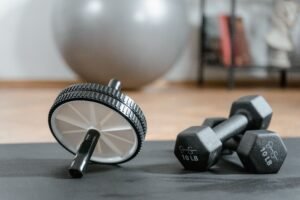
A cluttered home gym corner is one of the fastest ways to stop using it. Dumbbells rolling under the couch, a resistance band tangled in a drawer, a yoga mat you can never find when you actually want it — none of that makes you want to work out, and eventually you just… don’t.
This guide is a practical set of home gym organization ideas for beginners: real products, real prices, and a system for keeping strength, cardio, and flexibility equipment visible and easy to grab instead of buried in a pile. None of this requires a garage remodel — every idea here works in a bedroom corner, a closet wall, or a small apartment nook.
There’s research behind this too: a 2025 study on home clutter and well-being found that clutter measurably reduces how beautiful people perceive their home to be, which in turn is linked to lower overall well-being (ScienceDirect, 2025). It’s correlational, not proof that tidying up alone changes your mood — but it lines up with something most people already sense: a space that looks like a mess doesn’t invite you to spend time in it, workouts included.
Quick Comparison — Home Gym Organization Ideas
| Product | Best For | Price (approx.) | Rating |
|---|---|---|---|
| Wall Control Metal Pegboard Starter Kit | Customizable, heavy-duty wall storage | ~$66 | 4.6/5 |
| Amazon Basics Over-the-Door Multi-Hook Hanger | No-drill, renter-friendly storage | ~$10 | 4.4/5 |
| mDesign Foldable Fabric Storage Bins (2-Pack) | Soft storage for mats, bands, and loose gear | ~$20 | 4.5/5 |
| Amazon Basics 3-Tier Rolling Storage Cart | Mobile storage that moves with you | ~$32 | 4.5/5 |
| MyGift Rustic Metal & Wood Wall Organizer Rack | Small accessories, decorative + functional | ~$21 | 4.5/5 |
Our Top Picks for Home Gym Organization
Wall Control Metal Pegboard Starter Kit — Customizable Wall Storage
This is the closest thing to a real “system” on this list: two galvanized steel pegboard panels plus 12 hooks, so you can rearrange storage as your equipment collection grows instead of committing to fixed shelf positions. It’s the same style of pegboard used in professional garage gyms, just scaled to a starter size.
Why we recommend it: Pegboards are infinitely reconfigurable — move a hook, add a basket attachment, rearrange everything in five minutes if your equipment changes. That flexibility is hard to beat if you’re not sure yet exactly what your setup will look like in six months.
Pros:
- Fully customizable and expandable over time
- Heavy-duty galvanized steel holds real weight (bands, light dumbbells, jump ropes)
- Compatible with standard 1/4″ and 1/2″ pegboard accessories
Cons:
- Requires mounting into wall studs — not ideal for a rental you can’t drill into
- Higher upfront cost than a single hook rack or bin
Amazon Basics Over-the-Door Multi-Hook Hanger — No-Drill Storage
If you rent, or just don’t want to put holes in a wall, an over-the-door hanger solves the exact same problem as a pegboard without any installation. Hang it over a closet or bedroom door and you instantly have a spot for resistance bands, a jump rope, or a gym bag.
Why we recommend it: This is the lowest-friction organization upgrade on the list — no tools, no drilling, and it’s gone in seconds if you move. Perfect for small apartment home gym setups where every wall is already spoken for.
Pros:
- Zero installation — hangs directly on any standard door
- Fully renter-friendly and reversible
- Inexpensive way to get equipment off the floor
Cons:
- Limited weight capacity compared to a wall-mounted pegboard
- Only works where you have a spare door to use
mDesign Foldable Fabric Storage Bins (2-Pack) — Soft Storage for Mats and Bands
Not everything belongs on a hook. Yoga mats, resistance bands, and grip accessories are easier to manage tossed into a soft bin than hung individually — and these collapse flat when you’re not using them, so they don’t take up permanent space.
Why we recommend it: Bins are the fastest win for anyone whose equipment currently lives in a pile on the floor. It’s a five-minute fix: sort everything into one or two bins, and the “clutter” instantly reads as “storage.”
Pros:
- Collapsible — stores flat when empty
- Handles make it easy to pull equipment out for a workout and put it back after
- Works on a shelf, in a closet, or under furniture
Cons:
- Fabric isn’t as durable long-term as metal or wood storage
- Not ideal for heavier items like dumbbells
Amazon Basics 3-Tier Rolling Storage Cart — Mobile Storage That Moves With You
A rolling cart solves a problem fixed storage can’t: what if your “gym” is really just whatever open floor space you have that day? This cart holds water bottles, a towel, small weights, or bands, and rolls wherever you’re actually working out — bedroom one day, living room the next.
Why we recommend it: For anyone without a dedicated room, a mobile cart beats built-in storage every time. It also doubles as a between-set staging area so you’re not walking across the room mid-workout.
Pros:
- Goes wherever you work out — no dedicated space required
- Three tiers separate equipment types (weights, accessories, water/towel)
- Also useful outside workouts, so it’s not a single-purpose buy
Cons:
- Takes up floor space when parked, unlike wall-mounted options
- Lighter-duty than fixed shelving — not for heavy plates
MyGift Rustic Metal & Wood Wall Organizer Rack — Small Accessories, Done Nicely
Rounding out the list is a smaller wall rack for the accessories that don’t need a full pegboard — jump ropes, lifting straps, a resistance band or two. The rustic wood-and-black-metal finish means it also functions as decor, not just storage, if you want your setup to look intentional. We’ve featured this rack before because it consistently earns its spot: it’s simply one of the best-looking budget options for small accessory storage.
Why we recommend it: For a setup that’s mostly organized already and just needs one more spot for loose accessories, this is a lower-commitment option than a full pegboard system.
Pros:
- Doubles as decor — doesn’t look like garage storage
- Eight hooks cover most beginner accessory collections
- Simple wall-mount installation
Cons:
- Not rated for heavy plates or large equipment
- Requires wall-mounting hardware and a stud or anchor, same as the pegboard
What to Look for When Organizing a Home Gym
Match the storage to the equipment, not the other way around. Hooks work for anything with a handle (bands, ropes, straps). Bins work for anything soft or oddly shaped (mats, gloves, foam rollers). Shelves and racks work for anything rigid and stackable (weights, plates). Trying to force one storage type to hold everything is usually where organization systems break down.
Rentals need no-drill solutions first. Over-the-door hangers, freestanding racks, and rolling carts all solve storage without permanently modifying a wall — worth prioritizing before a pegboard or mounted shelf if you don’t own your space.
Visible beats hidden, for equipment you use often. A bin with a lid you have to open every time you want a resistance band adds just enough friction to skip it some days. Save closed storage for things you use rarely, and keep daily-use equipment in the open.
Build in room to grow. A pegboard or modular rack scales with a growing equipment collection; a fixed set of hooks doesn’t. If you’re still in the early stages of building a home gym setup — see our under-$150 beginner setup guide if you’re starting from scratch — leave yourself some flexibility rather than buying storage sized exactly to what you own today.
Frequently Asked Questions
Do I really need dedicated storage, or can I just keep equipment in a corner? You can, but a floor pile is the most common reason people stop using their equipment — it’s harder to find what you need, and it visually reads as clutter rather than a workout space. Even one basic hook rack or bin noticeably improves both.
What’s the cheapest way to organize a home gym? An over-the-door hanger or a couple of fabric storage bins, both well under $25, solve the two most common problems (loose accessories and floor clutter) without any tools or installation.
I rent my apartment — what are my best options? Stick to no-drill solutions: over-the-door hangers, rolling carts, and freestanding bins. Anything that mounts to a wall (pegboards, wall racks) should wait until you own the space or have explicit permission to drill.
Should I organize by equipment type or by workout? By equipment type is simpler to maintain long-term — group all your bands together, all your weights together, and so on. Organizing by specific workout tends to fall apart as your routine changes.
Will organizing my space actually help me stick to working out? There’s no guarantee, but it removes friction, and friction is one of the most common reasons a home workout habit fades. If you want the full setup context, our guide to aesthetic home gym ideas on a budget covers the look-and-feel side of the same idea.
Final Thoughts
Good home gym organization isn’t about making your equipment look impressive — it’s about removing the small daily friction that makes you skip a workout. Pick one or two ideas from this list that match how you actually train, start there, and expand as your setup grows. A five-minute clean corner beats an elaborate system you never finish building.